
How to couple two Italvibras MVSI vibrator motors in line to double the centrifugal force, and how to size your installation.
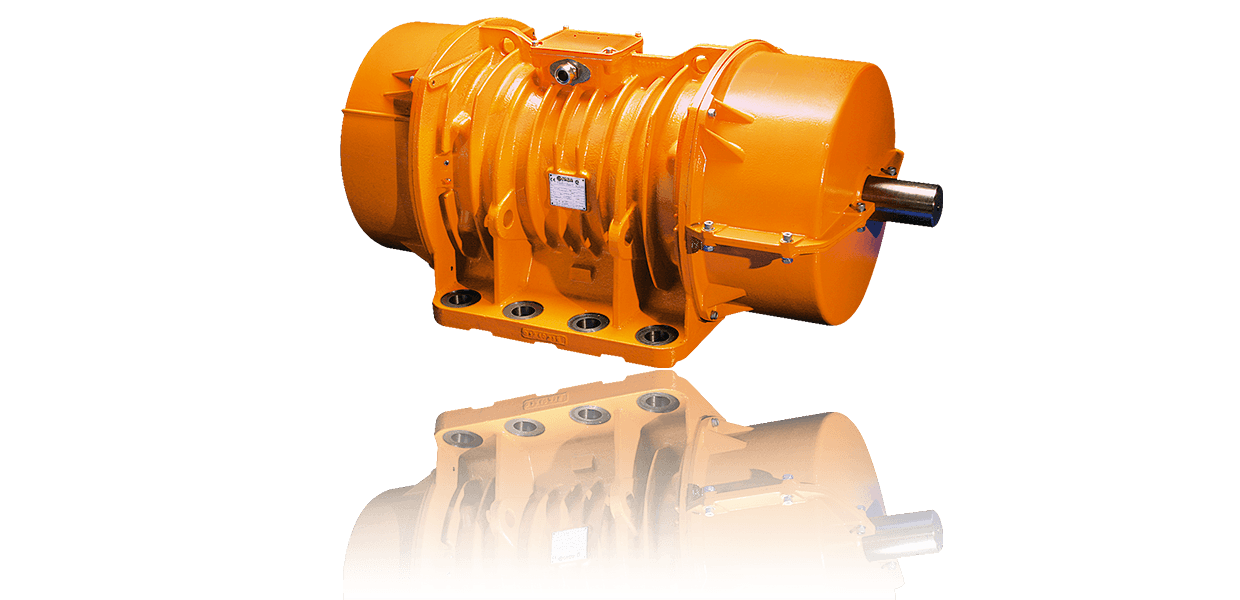
The ACC (coupling) version of an Italvibras MVSI vibrator motor is distinguished by its motor shaft extended on one side, rather than enclosed under the weight cover. This extension makes it possible to connect, through a mechanical coupling, two identical vibrator motors in line, which then rotate as a single assembly.
Any reference from the standard MVSI range can be built in the ACC version. On request, the shaft can even be extended on both sides to couple three or more vibrator motors.
In brief
A single vibrator motor produces a given centrifugal force. By coupling two identical vibrator motors through their shafts, the centrifugal force is doubled — useful when no single reference in the catalogue covers the requirement, or to spread the load over a wide structure (large screens, sieves, large vibrating frames).
1 vibrator motor
Force = F
2 coupled vibrator motors (MVSI-ACC)
Force = 2F
1. Calculate the total force required
As for a single vibrator motor: for a hopper, the centrifugal force required is usually between 1/20 and 1/10 of the weight of material held in the conical section.
2. Divide by two
The total force required is shared equally between the two coupled vibrator motors: each unit must deliver half the force calculated in step 1.
3. Choose the MVSI reference
Find in the standard MVSI catalogue the reference whose centrifugal force matches that half, then order it in the ACC version.
The two coupled vibrator motors must be identical and set to the same force percentage as one another — a difference in setting between the two creates a residual unbalance and premature wear. Our technical team can support you with this calculation and with the choice of the appropriate mechanical coupling.
Large screens and sieves
Spreading a high force over a wide vibrating surface, without concentrating all the load on a single mounting point.
Force beyond the standard catalogue
When the requirement exceeds the largest MVSI reference available on its own.
Large vibrating frames
Long structures where a single vibrator motor would struggle to transmit an even vibration along the whole length.
Three vibrator motors or more
On request, the shaft is extended on both sides to couple a chain of several vibrator motors.
Do all MVSI references exist in the ACC version?
Yes, any reference from the standard MVSI range can be built in the ACC version. The exact dimensions of the extended shaft depend on the reference and on the coupling chosen — to be confirmed with our technical team. See also the full technical specifications below.
Must both vibrator motors be identical?
Yes. Coupling is always made between two vibrator motors of the same reference, set to the same centrifugal force.
Can more than two vibrator motors be coupled?
Yes, on request the shaft can be extended on both sides to connect three or more vibrator motors in a chain.
How do you obtain dimensions and a quote?
Shaft dimensions vary according to the reference and the type of coupling — they are not standardised in the catalogue. Contact our technical team with your requirement (total force, space available) to receive a costed proposal.
Power supply
Three-phase voltage from 230V to 690V, at 50Hz or 60Hz. Supply is also possible through a PWM inverter from 20Hz up to the nameplate frequency, on a constant-torque installation.
Number of poles
2, 4, 6 and 8 poles as standard, other polarities available on request.
Duty
Continuous duty (S1) at the maximum declared centrifugal force and electrical power.
Centrifugal force
Very high centrifugal forces can be reached, multiples of the centrifugal force of each vibrator motor.
Insulation class
Class F (155°C), class H (180°C) on request.
Electric motor
Three-phase induction. Winding insulated by the « drip » system with class H resin. The rotor is die-cast aluminium (squirrel cage).
Discover the standard MVSI range
·
Request a quote →
Informative content, based on Italvibras technical documentation. Exact dimensions and coupling arrangements must be confirmed with our technical team.