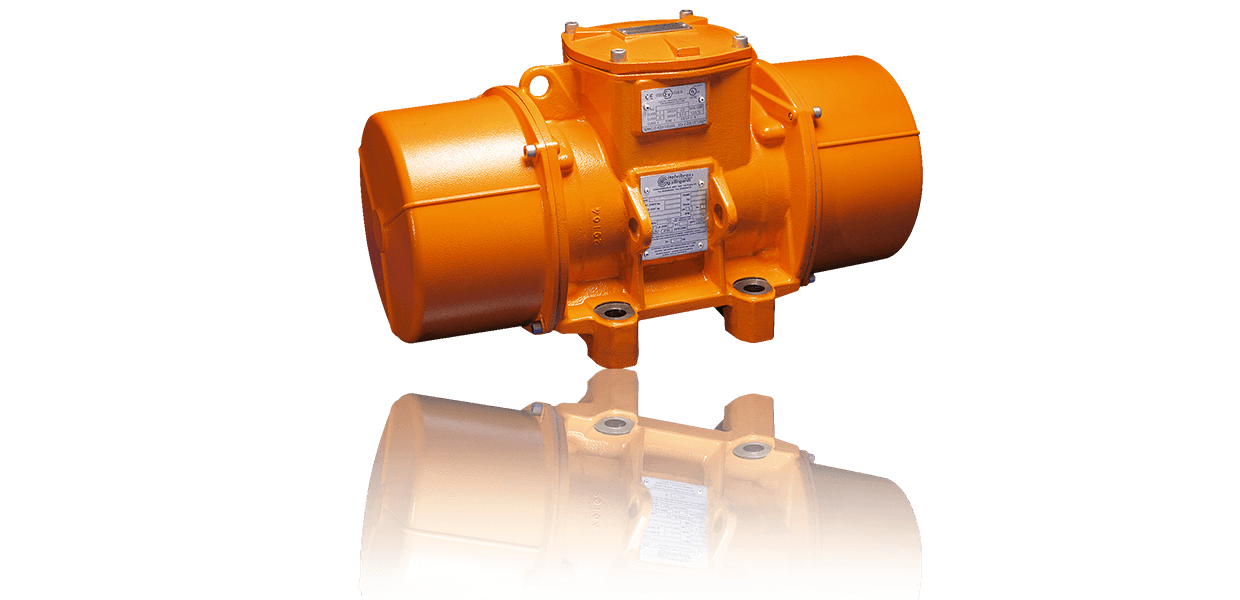
Choosing your polarity : what is really at stake
Polarity does not only change the speed. It changes the very nature of the vibration transmitted to your machine, and that is what decides the result.
Two relationships govern everything. First, centrifugal force increases with the square of the speed : with identical eccentric weights, a motor running half as fast produces four times less force. To obtain the same force at low speed, a much higher static moment is therefore needed — hence noticeably heavier machines in 6 and 8 poles. Second, the amplitude of the movement depends on the ratio between that static moment and the total mass set in vibration, not on the speed.
Practical consequence : at equal force, a slow motor delivers few impulses but of large amplitude, a fast motor delivers many impulses of small amplitude. Amplitude moves the material ; frequency releases and fluidises it. The whole question is which of the two your application requires.
2POLESMany impulses, little amplitude3,000 / 3,600 rpm
At 3,000 rpm, the CDX delivers fifty impulses per second. Each is short and of small amplitude : it breaks the adhesion between grains and between product and wall, without really moving the mass. It is the tool of releasing, not of conveying.
Best when
- The product is dry, fine and free-flowing : powders, granules, dry sand
- The aim is to release material stuck to a wall, a screen or a filter sleeve rather than to move it forward
- You want to de-aerate and compact — fresh concrete is treated at this frequency
- Size and weight matter : at equal force, this is the most compact polarity
- Screening must be fast and selective on fine cuts
Avoid when
- The product is wet, sticky or cohesive : high frequency compacts it instead of freeing it
- You need to convey over several metres — the amplitude is too small to sustain the advance
- The structure is light or slender : 50 Hz puts heavy demands on welds and bolting
- The product is fragile and copes badly with repeated impacts
On CDX : 9 references from 2.96 to 46.2 kN, sizes 10 to 80. The three smallest are also available single-phase.
4POLESThe compromise, and the default choice1,500 / 1,800 rpm
1,500 rpm is the speed that covers most installations. The amplitude becomes sufficient to set the material in motion, while keeping enough frequency to release it. It is also the best-stocked polarity in the range, so the one where the exact force required is most easily found.
Best when
- You cannot decide : start here, then move according to the behaviour observed
- The application combines releasing and extraction, the common case of hoppers and silos
- The product is moderately free-flowing, with a moisture content that varies over time
- It is a conveyor or trough of moderate length
- You are looking for a precise force : this is the most finely stepped polarity
Avoid when
- The product is distinctly sticky or forms stubborn bridging : move down to 6 poles
- The aim is to concrete : 2 poles remain the reference for de-aerating
- The conveyor is long and the flow must remain steady along the whole length
On CDX : 11 references from 2.09 to 49.1 kN, sizes 10 to 80. The four smallest are also available single-phase.
6POLESAmplitude at the service of difficult materials1,000 / 1,200 rpm
At 1,000 rpm, the movement becomes markedly wider. Each impulse clearly moves the material, which makes it possible to break bridging that a fast vibration would merely compact. The drawback is mechanical : at equal force, these machines are appreciably heavier and bulkier.
Best when
- The product is wet, cohesive, clayey or laden with fines
- Bridging re-forms despite correct mounting in 4 poles
- La mass to be set in motion is large : large hoppers, silos, heavy screens
- The particle size is coarse and the blocks must be freed
- The structure is massive and copes well with low-frequency loading
Avoid when
- The product is fine and dry : amplitude is useless and fatigues the structure for nothing
- The installation is light : the weight of the motor itself becomes a problem
- Space is tight : expect a larger frame than in 4 poles for the same force
On CDX : 11 references from 0.33 to 220 kN, sizes 10 to 110. This is the polarity covering the widest force range in the series.
8POLESThe slow, steady movement750 / 900 rpm
750 rpm gives the widest vibration in the range for a given force. The product is lifted and set down infrequently, but decisively. That is what allows it to advance steadily without being churned, and to be handled without damage.
Best when
- You need to convey over a long distance with a steady flow
- The product is fragile and must not be broken : the rarity of impacts preserves it
- The product is sticky, greasy or wet and adheres to the bottom of the trough
- You want a slow, controlled feed at the process inlet
- The installation includes vibrating dryers or coolers, where residence time matters
Avoid when
- The aim is to compact or de-aerate : the effect sought is the opposite
- Le screening must be fast : the frequency is too low for good screening efficiency
- The force-to-size ratio is decisive : this is the least favourable polarity on that point
On CDX : 9 references from 1.02 to 177 kN, sizes 20 to 110.
The method, in order
- Start from the product, not from the force. Dry and free-flowing points to the top of the table, wet or sticky to the bottom. That criterion decides the polarity.
- Then work out the force. Rules of thumb used at Audimat : for a hopper, a centrifugal force of the order of one tenth to one twentieth of the weight of material to be set in motion ; for concrete, allow roughly one kilogram of force per kilogram of material. These orders of magnitude do not replace a study, they keep you from starting off wide of the mark.
- Check that the machine can take it. Motor weight, flat bearing surface to 0.25 mm, new class 8.8 bolting, tightened to torque. Too flexible a structure will absorb the vibration instead of transmitting it.
- Set downwards, not upwards. The eccentric weights are adjusted from 0 to 100 %. Better to choose the reference slightly above and reduce, than to be stuck at maximum.
- Check the current drawn with a clamp meter after commissioning. If it exceeds the nameplate value, it is the spring system or the frame that must be reviewed before touching the weights.
A reminder that saves a lot of disappointment : never vibrate a closed hopper. With no room to expand, the material compacts instead of flowing, and the vibration produces the opposite of the intended effect.